
Reimagining Meeting Spaces: From Huddle Rooms to Hybrid Hubs
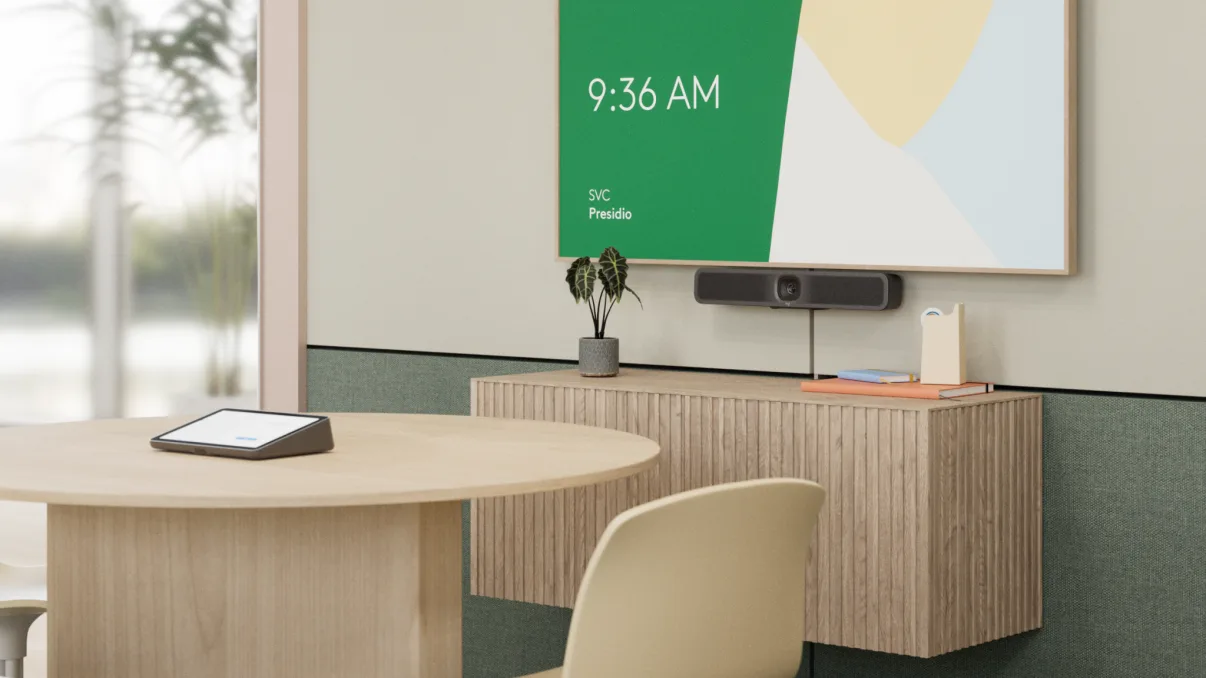
The accelerating shift toward hybrid working has fractured the traditional “one-size-fits-all” conference room. What teams need now is flexibility: the ability to convene quickly, on any scale, with minimal friction. MeetUp 2 and Rally Board 65 represent the two extremes of that spectrum, and together they illustrate how organisations can rethink workspace design.
MeetUp 2 targets small and huddle rooms, the corners of offices or remote-working pods where two to six people gather spontaneously.
Rally Board 65 scales up to mid-sized meeting rooms or shared open spaces, doubling as a touchscreen whiteboard and flexible collaboration hub.
By offering both solutions, Logitech signals a more nuanced future: one where companies mix and match devices based on room size, purpose, and collaboration style rather than forcing all meetings into a one-room-fits-all approach.
MeetUp 2 Small Room Simplicity with AI Smarts
The MeetUp 2 embodies the principle that sometimes, less is more. Its strength lies in delivering high-end conferencing where you don’t have the space (or need) for a full boardroom setup.
Key strengths:
- Compact all-in-one design: a USB-based camera + mic array + speaker bar, deployable in minutes.
- Ceramic-grade video: 4K resolution, 4× digital zoom, and a generous 113°–120° field of view, enough to capture everyone in a small room.
- Intelligent audio and video: Six-mic beamforming array with omnidirectional capability picks up voices clearly, even if people are spread around the table. AI features such as RightSight 2 (auto-framing) and RightSound 2 (noise suppression) further simplify the experience.
- BYOD and management flexibility: Works with popular platforms (e.g., Microsoft Teams, Zoom, Google Meet), can be deployed via an in-room PC or a laptop, and managed centrally through Logitech Sync.
- Sustainable build: Parts of the device use certified post-consumer recycled plastic.
What this means strategically:
For distributed organisations with multiple small meeting spaces - huddle rooms, hot-desking zones, satellite offices - MeetUp 2 delivers enterprise-grade conferencing, without the complexity or cost of large room systems. With its small footprint, it echoes the “run meetings on demand” ethos of hybrid work.
Rally Board 65 A Room Scale Collaboration Platform
Where MeetUp 2 focuses on simplicity and small-room speed, Rally Board 65 aims to transform how teams collaborate, especially in hybrid or dynamic environments where meetings may require both video conferencing and interactive whiteboarding.
Core capabilities:
- Large format touchscreen: A 65? 4K multitouch display that doubles as a digital whiteboard. Ideal for brainstorming, workshops, or hybrid discussions where visuals matter.
- Integrated AV: Built-in PTZ camera, mic array, dual speakers, everything needed for conferencing, inside one sleek unit.
- AI-driven spatial awareness: Features such as Camera Zone (to define visual framing), Mic Zone (to limit audio pickup), and a Depth Blur that obscures surroundings are helpful in open spaces or shared environments.
- Smart environmental and occupancy sensing: Radar sensors detect when people enter and leave rooms, and environmental sensors monitor temperature, CO2 and humidity. In tandem with Logitech Sync, this enables organisations to collect data on room usage and optimise air quality and energy use.
- Flexible deployment: Rally Board 65 can be wall-mounted, placed on a low cabinet, or mounted on a mobile cart and can be flipped to reposition the camera above or below the screen, depending on the setup.
Strategic implications:
Rally Board 65 transforms meeting rooms into flexible collaboration zones. For businesses embracing hybrid work, it removes friction by giving teams one device that does everything: conferencing, whiteboarding, hybrid collaboration and all without complicated wiring or multiple devices. With the addition of occupancy and environmental sensing, it starts to provide data-driven insights about workspace usage and wellness, a subtle but important evolution in modern office design.
The Future of Hybrid Collaboration
Having both MeetUp 2 and Rally Board 65 in a company’s gear kit isn’t about redundancy. It’s about intentionality. It signals a shift from “digital fit-outs to check a box” toward “spaces designed for purpose.”
- Tailored spaces: small huddle rooms, larger hybrid spaces, open-plan zones, touchdown areas, each can be outfitted with the right tool.
- Flexibility and scalability: as teams grow or reorganise, devices like Rally Board 65 (with its mobile cart mount) can move where needed. MeetUp 2 makes it trivial to spin up new remote-capable rooms.
- Hybrid-first design thinking: with AI features, environmental sensing, and remote manageability (via cloud-based platforms), these devices treat collaboration as a malleable, data-driven experience, not a static legacy process.
- Sustainability credentials: from materials to energy efficiency (see the radar-based power-saving in Rally Board 65), Logitech’s newer devices suggest that sustainable design and enterprise-grade performance are no longer trade-offs.
Challenges and Considerations
Implementation requires thoughtful consideration.
- Cost and ROI: Rally Board 65, being a premium, 65? touchscreen + AV system, will carry a higher upfront cost than a simple webcam or mic. Organisations will need to justify that cost via utilisation. If the room sits empty most of the time, it may not represent value.
- User experience and training: While designed to be simple, interactive whiteboards and hybrid meeting tools still require a shift in how teams work, including adopting different meeting norms, making full use of whiteboarding, and trusting occupancy data.
- Room design constraints: Even mobile carts or wall-mounted units require space, proper lighting, and adequate seating arrangements. For some small offices, that may be prohibitive.
- Privacy and data governance: The environmental sensing and occupancy tracking in Rally Board 65 opens the door for smart-building insights. Companies must handle this data responsibly, especially if occupancy or usage data is tied to individuals.
Conclusion Why Collaboration Design Matters
MeetUp 2 and Rally Board 65 mark a subtle but meaningful shift in how we should think about workplace technology. These are not just better cameras or better screens. They are signals that video conferencing, once a stopgap during remote-work lockdowns, is evolving into a foundational layer of hybrid collaboration architecture.
For forward-looking organisations, that means redesigning meeting workflows, rethinking office layouts, and treating collaboration as a dynamic ecosystem. In that context:
- MeetUp 2 offers the agility to enable remote-ready small rooms - immediate, light on infrastructure, and scalable.
- Rally Board 65 offers the versatility to build collaboration hubs - spaces where teams meet, ideate, whiteboard, and connect across geographies, with minimal friction.
Together, and when deployed thoughtfully, they make a compelling case on the need for collaboration tools that meet the needs of all employees – whether they are remote, hybrid or office based.